


Top Summer Fire Culprits: BBQs & Cooking Appliances
In the warmer months, dwelling fires reach a natural peak. Discover the most common causes of these fires and our expert guidance on fire prevention.
As UK summers get hotter, the ground gets drier, which creates the perfect conditions for the spread of fire. According to government data, there was a spike in outdoor fire emergencies during the hot, dry summer months of June and July in 2023.
- In total, there were 21,246 outdoor fires in July 2022, nearly three times the previous year’s figure of 7,250.
- In August of the same year, this number reached 22,547, over three times the number of August 2021 (7,156).
And, if this year is set to be as hot, then we could be in a similar danger zone. There is a clear link between heatwaves and outdoor fires, and not by a small amount - a rise from roughly 7,000 to 22,000 between two different years is a startling change.
So, who and what is responsible for outdoor fires and how are they best prevented?
Key statistics
The most popular time for fires to start is between 3am and 5am with each hour accounting for 6.6% of fires. This is the time when grass is driest during hot weather.
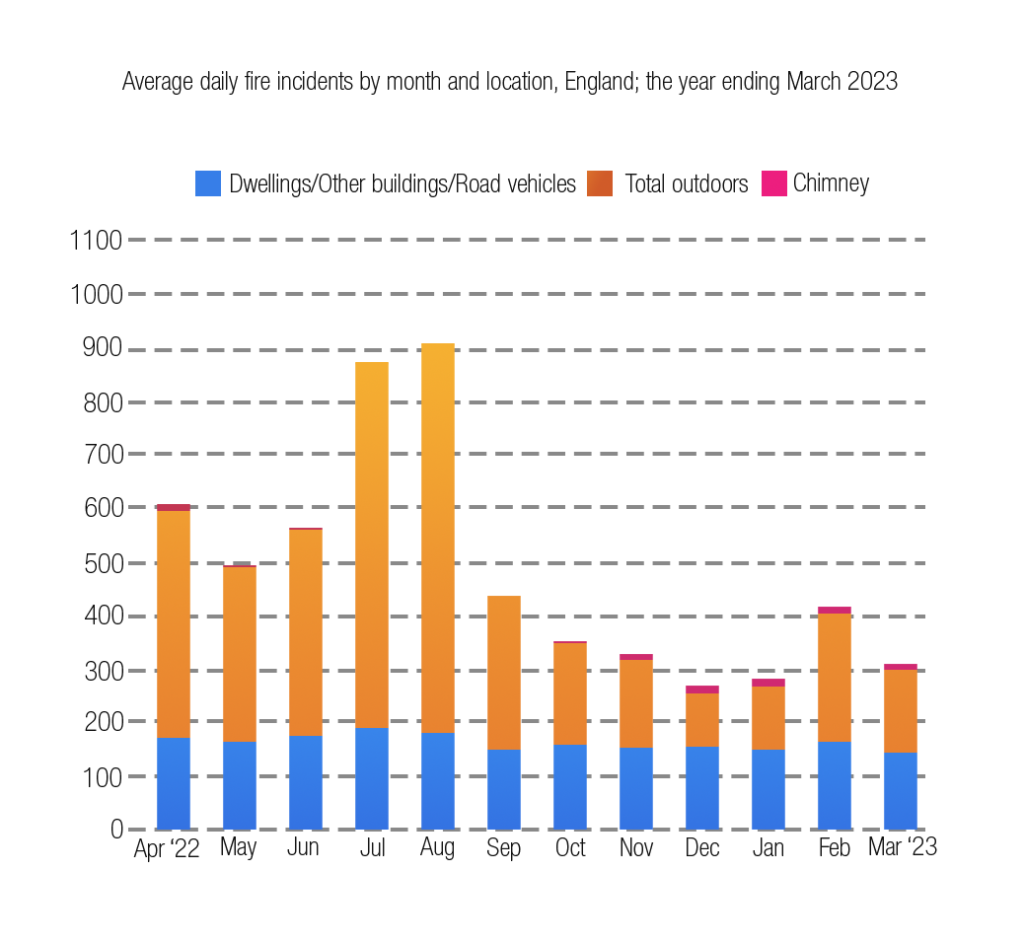
The daily rate of all fires for the year ending March 2023 was 490 fires per day, of which 320 per day (65%) were outdoor fires. The graph below shows that there was a stark increase in outdoor fires during the hottest summer months of July and August. This seasonality is supported by the increase in chimney fires during the winter months.
The quarter ‘July to September’ accounted for 26,323 (60%) of the 44,150 fires, which was the highest quarterly figure since the IRS was introduced and a 20% increase compared to the previous highest quarterly number in the year ending March 2019 (21,859).
Now, let’s explore the reasons summer creates the perfect conditions for these fires to start in the first place.
The perfect conditions for fire
When we have prolonged periods of dry, hot weather, the moisture in grass, plants and trees gets evaporated and can die. Meadow grass in gardens, especially when left to grow, will essentially become tinder, especially if any other refuse lies on top such as leaves, sticks and fabrics which become their most dry around midday to afternoon.
This helps explain why we see those spikes in outdoor fires during the summer months as shown in this graph:
In some cases, if grass fires develop into wildfires, they can spread at 14 miles per hour. On top of this, wind and elevation increase the rate of fire spread; in fact, for every 10 degrees of elevation a fire’s spread rate doubles.
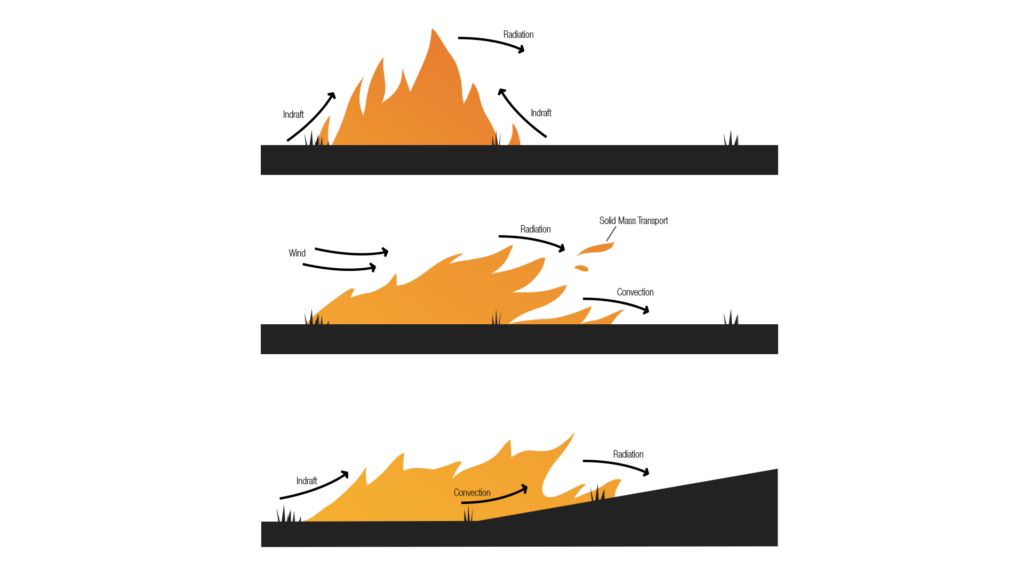
Diagram showing, from top to bottom; the spread of fire without wind, the spread of fire with wind, and the spread of fire on a slope.
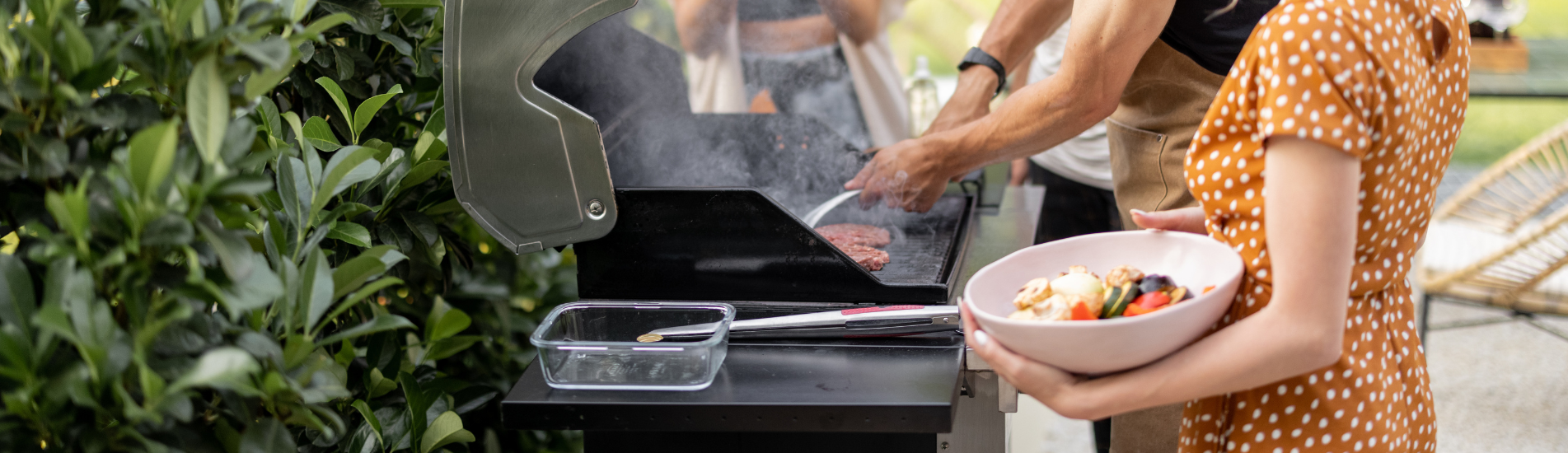
During the summer months, households often want to have a BBQ or to cook outdoors — and with that comes a whole host of new flammable materials, from charcoal to gas, cooking oil, and even flour. Mix all of these together and you have yourself a tinderbox.
BBQs are the most common cause of garden fires
Looking again at the government data, we can see that the most common cause of callouts for fire emergencies are caused by the careless handling of fire or hot substances, but also ‘placing articles too close to heat’, ‘faulty fuel supplies’, ‘ faulty appliances and leads’ and ‘mishandling of equipment or appliances’.
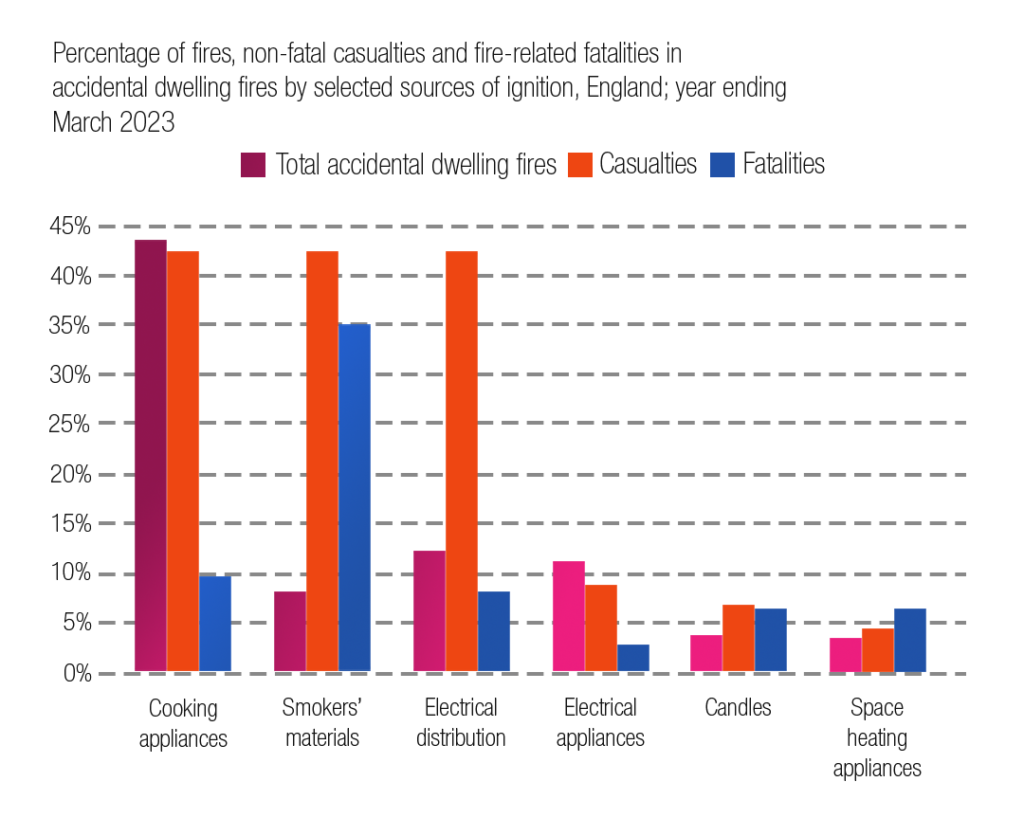
When we look at fires in dwellings, which includes gardens, the main cause becomes the ‘mishandling of equipment and appliances’.
Key statistics
Cooking appliances are responsible for starting 44% of all dwelling fires.
‘Food’ was the material mainly responsible for the spread of the fire in 15% of all dwelling fires and the item first ignited in 23% of all dwelling fires in the year ending March 2023.
Whilst cooking appliances were the largest ignition category for accidental dwelling fires they made up only 9.7% of the fire-related fatalities, whereas smoking materials were the source of ignition in 8.2% of accidental dwelling fires, but accounted for the largest proportion of fire-related fatalities in accidental dwelling fires at 35%. This suggests differences in location and time with the two ignition sources where cooking material fires are more easily spotted and evacuated.
Men are more likely to be non-fatal casualties in fires
According to the same government data, men are more likely to be non-fatal casualties in fires. The overall casualty rate for males was 131 million, while the rate for females was 89 million, a difference of 42 million or 38%.
Fatal and non-fatal results go up sharply with age, too, and there are many reasons why this could be the case, especially with the elderly, which we can largely dismiss from outdoor fire causes.
Nevertheless, one reason any group may be more likely to be hurt than another is because that group is more active around fire and flammable objects. According to a Wales Online survey conducted the same year as the fire data, around 46% of men interviewed said that they took control of cooking meat on the BBQ, and 14% of women said their partner ‘would not let them’ take control of the BBQ.
Anyone is capable of making a mistake, and adding alcohol into the mix certainly won’t help. Poorly maintained BBQs, mishandled flammable materials such as flour, oil, gas and charcoal, tiredness and alcohol consumption and the fact that BBQs usually happen in the afternoon when grass is at its driest - is the perfect combination for an out-of-control fire.
How to reduce the risk of outdoor fires
Whenever we start to think about reducing risk, we have to consider a wide variety of scenarios.
1. Positioning and preparing your BBQ
Place your BBQ on a flat surface where it is secure, preferably on pavement or concrete away from dry grass or wood. Make sure that other flammable materials, such as cooking oil, flour, charcoal or any gas canisters are kept away from the source of the fire, preferably on the other side of the garden or on a secure table away from the main area.
If you have a gas BBQ and you haven’t used it for a while, check for any wear or breaks, and if you need to change the gas cylinder make sure the tap is off first. If you’re using charcoal, be patient. Be careful with any lighter fluid and keep the bottle or container far away from the fire.
2. Keep safety items close by
Preferably you will have fireproof gloves nearby at all times, and your mobile phone ready to call in the case of an emergency. A bucket of water can be useful for any charcoal fires but not for any grease fire or gas BBQ. Sand is a good alternative, as well as a fire extinguisher and/or fire blanket.
3. Set up a control area
Keep children and pets away from the fire and make sure that any games happen far away from the BBQ. Position your BBQ with a good oversight of the garden in front of you so you won’t get any nasty surprises.
4. Put your fire out properly
Wait for your fire to cool before you move it or leave it too long. Turn it off, dampen any burning embers and keep an eye on it. Don’t throw any hot ash or coals into the bin. If you have gas, turn the burners off fully and disconnect the gas supply.
Conclusions: protecting property
When there is a heatwave in the summer months, dry surfaces, especially when covered in refuge, become extremely flammable.
Data shows that cooking materials and the mishandling of flammable materials are the most likely causes of dwelling fires. The fact that fires are more likely to start in the afternoon, when grass is driest too, means that these figures paint a picture where BBQs, both disposable ones out in public and ones at home, are placed in the perfect conditions to start fires, and they do.
Our advice, then, is to be extra cautious around this time of year, to safeguard against fires.
For more fire safety guidance and research, navigate to our Advice Centre.
Related Articles

Find The Best Rebated Drop Down Seal For Your Needs
Learn more about rebated drop down seals, their key features and benefits,...
Read more
Understanding The Differences Between Intumescent Sealant & Ablative Coating
Explore the unique properties and purposes of intumescent sealant and ablative coating,...
Read more

Now Stocking: The Trend by CCE
Find out everything you need to know about our latest rebated drop...
Read more