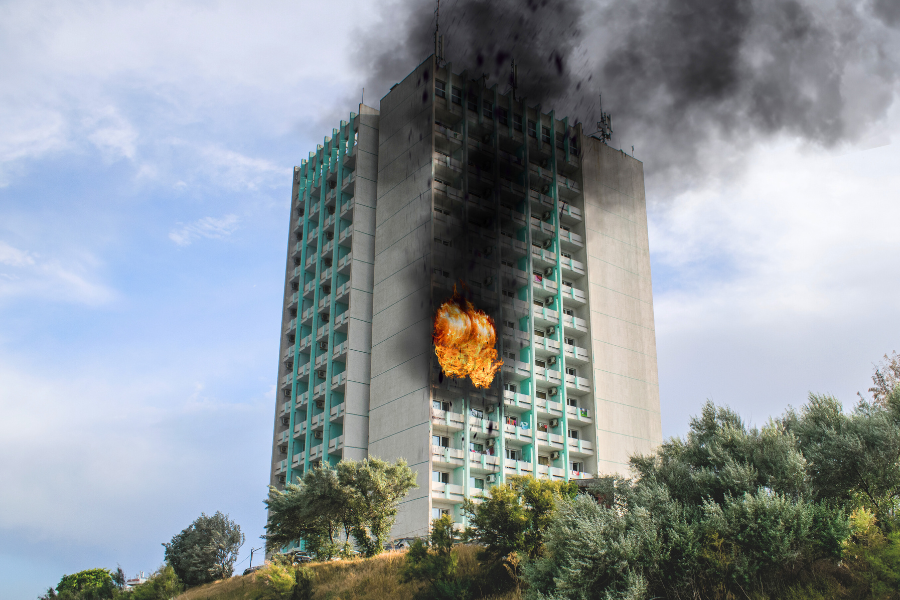
A fire strategy plan defines the fire safety objectives and performance requirements for a building and the methods by which these will be achieved.
It is a holistic document, detailing the implementation of fire safety from the construction phase, to the management of fire safety procedures and how these will be adhered to during occupancy.
As a fire strategy looks at how a building is constructed with fire safety in mind, it is usually created during the design phase. However, a fire strategy should evolve with the building and should be amended and updated as alterations or refurbs occur.
Which buildings need a fire strategy plan?
All buildings should have a fire strategy plan although it is sadly the case that many do not. However this has changed in recent years in the wake of the Grenfell tragedy and many buildings are now having fire strategy plans created retrospectively.
Complex builds such as renovations, a change of use or ambitious, design-led buildings will have to consider fire safety requirements more carefully and would often involve a trained fire engineer in the fire strategy planning to ensure the building is within regulations.
What is the difference between a fire strategy plan and a fire risk assessment?
A fire strategy plan looks at the building as a whole, taking into account how the building is constructed, the compartmentation strategy and means of escape. As mentioned above, they are created at the design stage and dictate how it is constructed, the materials used, and how it should be used by its inhabitants. In this way it is a more proactive document than a fire risk assessment.
A fire risk assessment is carried out once a building is constructed and is in use. It is done on a regular basis and looks at any potential fire hazards in the building and what should be done to put them right. As a result, a fire risk assessment is more reactive to fire safety issues and does not look at how the building is constructed, the materials used etc.
What is included in a fire strategy plan?
A fire strategy reviews a range of aspects of a building in relation to its fire safety. These are outlined below:
Legislation
The building must achieve the performance requirements of building regulations. Approved documents are usually used as guidance, the most common of these being Approved Document B and the British Standard BS9991 and BS9999.
Means of Escape
The second aim of a fire strategy is to evaluate means of escape. The travel distances in a building should be evaluated and whether the escape routes that lead to safety are suitable for the inhabitants of the building. For example, are emergency lighting and fire exit signs provided along with clearly displayed evacuation plans?
Fire Spread and Control
The fire strategy should identify the extent of fire protection required throughout the building in light of the fire spread risk both internally and externally across rooves, cladding and adjacent buildings.
Construction
Compartmentation should be specified for the construction phase, along with any fire stopping and fire suppression systems needed.
Fire Service Access
The fire strategy should outline the design standards for external vehicle access, location and number of access points and if firefighting lifts, rising fire mains etc. are required.
Fire Safety Management
The evacuation strategy and fire safety training needed for building staff should be specified and in line with Regulation 38.
How We Can Help
A fire strategy is an essential document for the construction and renovation of buildings and should be consulted and updated when any refurbishments are carried out.
At FireSealsDirect we stock a wide range of passive fire protection products to assist in the fire compartmentation of a building and our knowledgeable Customer Care team is on hand to provide advice for your project.
Contact us at [email protected] or phone 029 2085 7959 for more help and information tailored to your needs.