














Fire False Alarms Waste 14,575 Days in Last Decade
Discover the startling statistics revealing that fire false alarms consumed 349,806 hours in England over the past decade. Explore further for details.

Written by Esme
10th May 2024

In the year ending September 2023, Fire & Rescue services (FRSs) attended 246,529 fire false alarms, the largest year ending September figure since 2011.
False alarms not only strain resources, but also pose a risk to life and property by diverting essential services from real emergencies. With false alarms accounting for a considerable percentage of call-outs annually, we were curious to see just how much time was being wasted by these errors.
What is a ‘fire false alarm’?
Firstly, we must define a fire false alarm. According to the Home Office, a fire false alarm is ‘where an FRS attends a location believing there to be a fire incident but, on arrival, discovers that no such incident exists or existed’
Fire false alarms can be broken down into 3 motive-based categories:
- Good intent: Calls made in good faith in the belief that there is a fire.
- Malicious intent: Calls made with the intention of getting the FRS to attend a non-existent incident.
- Due to apparatus: Caused by a fire alarm or fire-fighting equipment (including accidental initiation by persons) in error.
As experts in passive fire protection, we will be focusing on this latter category.
Let’s dive into our findings.
Here’s a summary of our key findings:
- Fire false alarms wasted 349,806 hours in England in the last decade.
- Fire false alarms wasted 14,575 days in England in the last decade.
- The number of fire false alarms increased by 8.0% compared with 10 years ago.
- There has been a 20% decrease in malicious fire false alarms from 10 years previously.
- Faulty apparatus is the largest timewaster, with a 14% increase from 10 years previously.
- Fire response times are getting slower, increasing by 49 seconds compared with 10 years ago.
- In 2022/23 alone, fire false alarms wasted 37,164 hours (or 1,549 days)
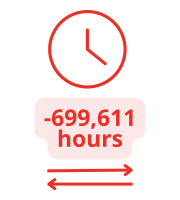
- Including return journeys, 699,611 hours (or 29,150 days) were wasted by fire false alarms in the past decade.
You can find further data and information on our findings below.
1. Fire false alarms wasted 349,806 hours in England in the last decade
Between the years 2012/13 and 2022/23, fire false alarms of all types for primary fires caused fire and rescue services in England to waste an estimated 349,806 hours.
This figure accounts for the average response time for primary fires across the last decade.
As we will explore, the actual figure is likely to be much higher, when accounting for slower response times in recent years and the added time of FRSs attending to and driving back from fire false alarm incidents.

2. Fire false alarms wasted 14,575 days in England in the last decade.
The total number of fire false alarms for primary fires in England since the year 2012/13 is estimated to have wasted 14,575 days of fire and rescue service workers’ time.
To break this down further, this equates to:

3. The number of fire false alarms increased by 8.0% compared with 10 years ago
We saw an increase in the total number of fire false alarms over the decade that we studied.
In the year 2022/3 the total number of fire false alarms:
- increased by 3.1% compared with the previous year
- Increased by 6.3% compared with 5 years ago
- And increased by 8.0% compared with 10 years ago
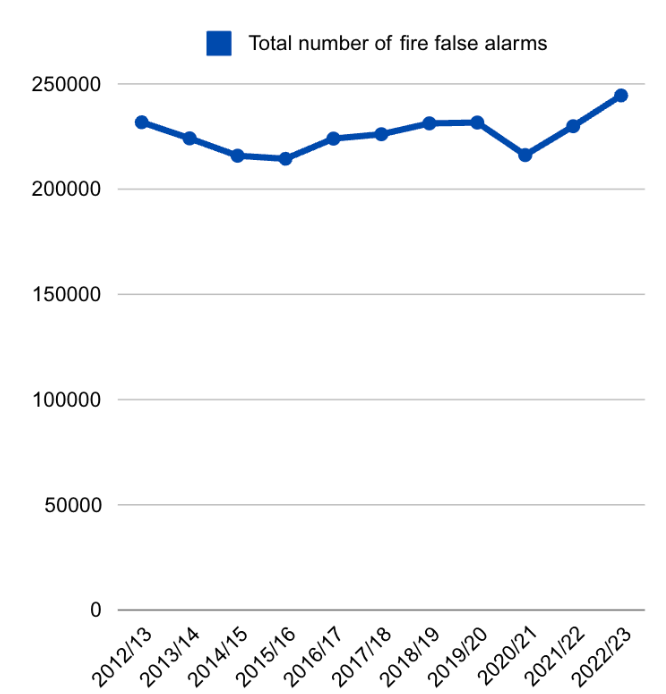
Interestingly, fire false alarms attended by FRSs in England were decreasing until the year ending December 2015. However, since then, excluding an anomalous period of decreases around the COVID-19 pandemic, there has been a gradual increase in fire false alarms until September 2023.
Below we split out the total fire false alarms into their three motives: good intent, faulty apparatus, and malicious intent.
4. 20% decrease in malicious fire false alarms from 10 years previously
Promisingly, there has been a 20% decrease in the number of fire false alarms due to malicious intent over the past decade.
This indicates a stronger awareness from the public as to the value of fire safety and rescue services’ time and the implications of false alarms.
5. Faulty apparatus is the largest timewaster, with a 14% increase from 10 years previously
Interestingly, though, the number of fire false alarms attributed to faulty apparatus is on the increase, seeing an uplift of 14% over the past decade.
Now the largest timewaster, faulty apparatus caused 174,362 fire false alarms in the year ending September 2023 — the highest annual figure in the past decade.
This represents an increase of 6.8% from 2022 and an increase of 14% from 5 years previously.

As passive fire protection experts, we cannot stress the importance of regularly checking fire safety equipment regularly. In business premises, this activity should be done iteratively as part of a fire safety risk assessment completed by a fire warden.
For more guidance on this, head to our Advice Centre.
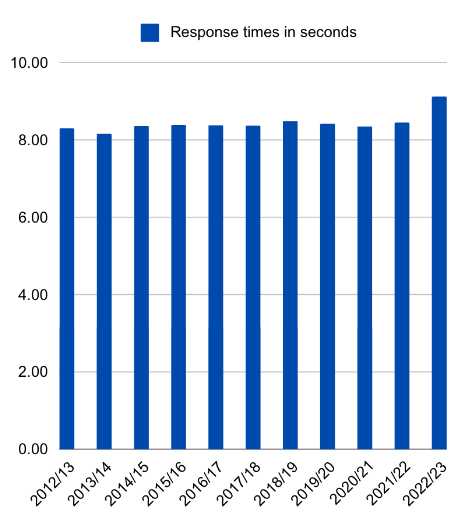
6. Fire response times are getting slower, increasing by 49 seconds compared with 10 years ago
On average, the response times of fire and rescue services to primary fires have increased over the past decade — getting slower.
Response times are defined as, “The minutes and seconds elapsed from the time of call to the arrival of the first vehicle at the incident.” For transparency, the following incidents are not included in response times:
- Road vehicle fires, where the road vehicle was abandoned.
- Where the location of the fire was a derelict property.
- Where an FRS learned of the fire when it was known to have already been extinguished (known as “late calls”).
- Where the total response time for an incident was over an hour or less than 1 minute (to avoid anomalies skewing averages).
- Where the sequence of events in an incident is not recorded in a logical sequence, either through recording error or absence of data.
The graph below shows the average response time year on year.
7. Fire false alarms wasted 37,164 hours (or 1,549 days) in 2022/23
Looking at the most recent data for 2022/23, there were 244,497 fire false alarms. Of this figure, 167,636 incidents were caused by faulty apparatus. In total, for this year, nearly 40,000 hours of fire and rescue services time were wasted.
8. Including return journeys, 699,611 hours (or 29,150 days) were wasted by fire false alarms in the past decade
Our initial figure of 14,575 days wasted only accounts for the initial response time from call to arrival at the incident. This does not include the time spent seeing to the fire false alarm, dealing with the public, or the return journey made by fire and rescue services.
With that being said, the total number of hours wasted is likely to be much larger. In order to try and get a more accurate figure, we used the average fire response time as a rough estimate for the return journey too to find that it is more like 699,611 hours wasted.

The breakdown
Using government data showing the incidents attended by fire and rescue services in England (by incident type and fire and rescue authority), we analysed the number of fire false alarms in England for the 10-year period between 2012/2013 and 2022/23.
First, we accumulated a total for the number of fire false alarms and also broke this down into intent.
Then, we examined the average response times by location and fire and rescue authority/geographical category in England for the same date range, to calculate an average that could be used in our equation.
To find the total number of hours wasted, we multiplied the number of fire false alarms by the average fire response time and converted the answer into hours.
Our hours wasted figure did not include the drive back to the station and the time spent attending to the fire false alarm, however, we conducted a separate calculation to include the return journey.
In conclusion…
As the data above shows, the number of fire false alarms is on the increase — and has been significantly since 2020/21. Concerningly, fewer of these false alarms are being attributed to mistakes with positive intent and, instead, to faulty apparatus.
As a leading provider of passive fire protection, we have first-hand experience working with fire safety equipment. In commercial and residential properties alike, it is essential that both passive and active fire safety equipment is inspected regularly to avoid costly malfunctions.
Prevent wasted time
It is recommended that every 12 months, fire risk assessments are reviewed — including the equipment mentioned in them. If equipment is kept in good working order and inspected regularly, the likelihood of fire false alarms decreases significantly, reducing the number of hours wasted by Fire & Rescue Services.
Buy yourself more time
Installing passive fire protection products such as intumescent seals is not only a legal requirement for fire doors but an excellent way to buy more time during a fire event How? These products are designed to compartmentalise buildings, preventing the open spread of smoke and reducing the speed at which fire travels. This not only gives the emergency services more time to handle the fire, but can gain crucial seconds for safe evacuation.
Find out more on the FireSealsDirect Advice Centre.
Related Articles
Choosing The Right Lock For Your Fire Door
Discover different types of fire-rated locks & factors to consider when selecting...
Read more

Everything You Need To Know About The Applique Drop Down Seal
Find out everything you need to know about our best-selling surface mounted...
Read more

Fire Escape Regulations in the UK
Learn more about Fire Escape Regulations in the UK and what is...
Read more